Perimenopause and Hair Loss: What’s Actually Happening (And What Helps)
The Shower Drain Moment
There’s a specific moment when you notice. For me, it happened on a Wednesday morning in the shower. I pulled my wet hair back into a ponytail and something felt… different. Lighter? I looked down. My palm was basically a small furry animal. Not a few strands. A handful. The kind of handful that makes you do a silent scream because you don’t want to alarm your kids by yelling about hair loss at 6 AM.
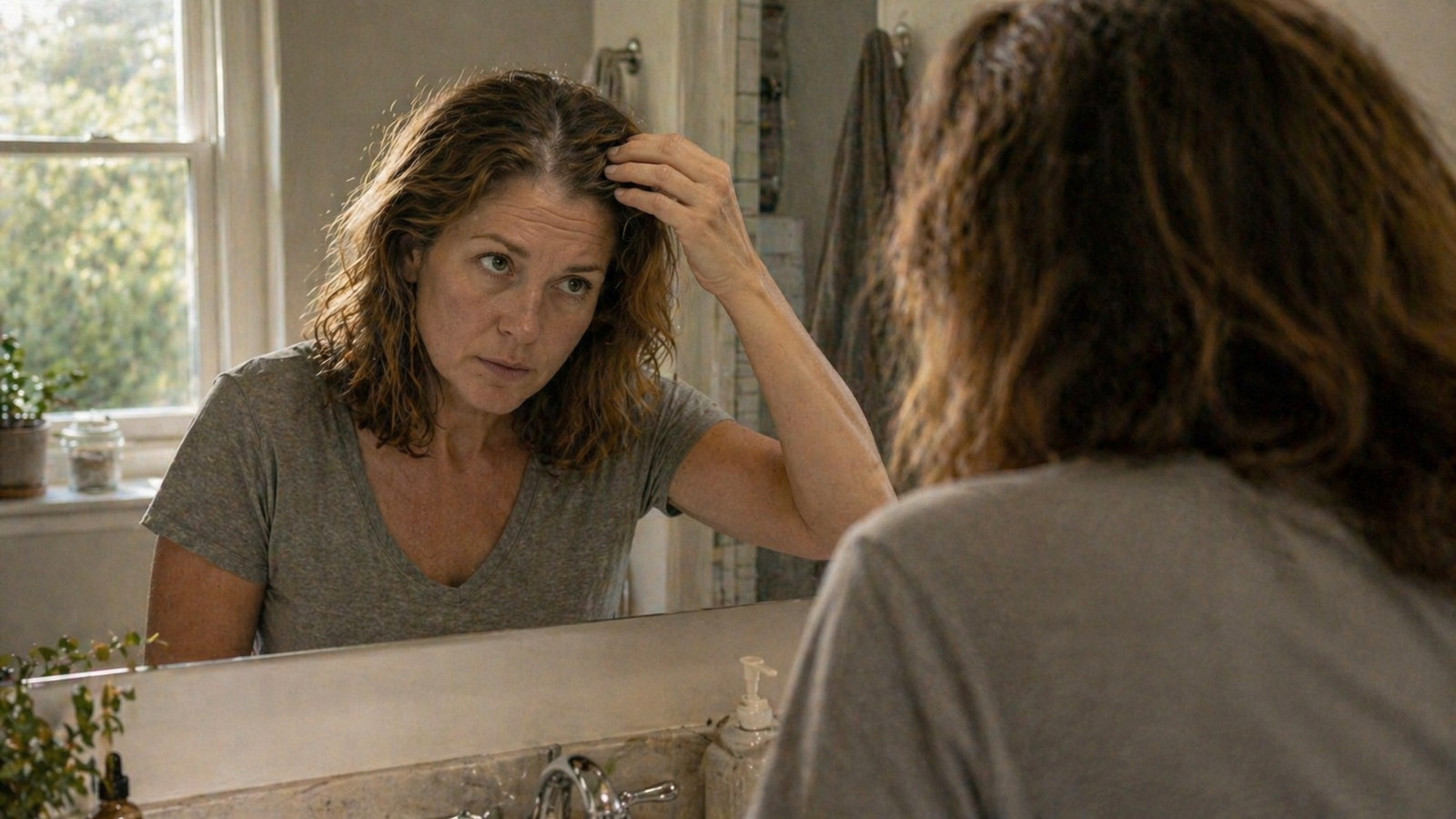
Then you start seeing it everywhere. The sink. Your pillow. That part in your hair that used to be a neat little line is now something wider, lighter, kind of sad-looking. You catch yourself checking your hairline in every reflective surface like you’re a detective investigating a crime scene. Your own hair is now the crime.
If this is your life right now, first: you’re not losing your mind. Second: your hair is actually leaving. Third: this is hormonal, it’s temporary (mostly), and there are actual things that help. Not things that cost $300 and come in a mysterious powder from an Instagram ad. Real things.
Why Your Hair Is Staging a Breakup
Here’s what’s happening at the follicle level. Your hair grows in cycles. The growth phase (anagen) lasts about two to six years normally, where hair cells divide rapidly and you get that thick, strong hair you’ve been enjoying since your twenties. Then it goes into a resting phase (telogen), and eventually it sheds. This is normal. You shed 50-100 hairs a day without noticing because new growth is keeping up with the exit.
Perimenopause puts a wrench in this system. Specifically, the hormonal chaos does.
Here’s where it gets interesting: your hair follicles have receptors for both estrogen and androgens (male hormones like testosterone). During your prime reproductive years, estrogen is high and it keeps your hair in that long growth phase. You’ve got thick hair, strong nails, skin that’s relatively forgiving. It’s called the estrogen tax, and you collect the dividend during your fertile years.
Then perimenopause arrives. Estrogen starts its slow decline (not a cliff drop, a decline that feels like a slow-motion car accident). Meanwhile, your ovaries are still making testosterone, and relatively speaking, testosterone becomes more dominant. It’s not that you suddenly have a lot of testosterone. It’s that you have less estrogen to balance it out.
This is where DHT enters the chat. DHT (dihydrotestosterone) is made from testosterone. Some of your hair follicles are sensitive to DHT. It tells those follicles to shrink. The technical term is “miniaturization.” Your thick hairs become fine hairs. Fine hairs become barely-there wisps. And more of your hairs move into that resting, shedding phase faster than they should.
Add in cortisol (hello, midlife stress) and reduced iron levels (perimenopause can mess with your cycle and your ferritin), and you’ve got a perfect storm for hair thinning. Your poor follicles didn’t sign up for this.
What Actually Helps
The frustrating news: you can’t completely reverse this with a supplement. Hair loss is multifactorial and hormonal. If it were truly just biotin deficiency, we’d all be fixed.
The good news: you can slow it down, improve what’s currently growing, and support your follicles with actual science.
Get your iron levels checked. Specifically, ask for ferritin, not just hemoglobin. You can have “normal” iron and still have depleted ferritin, which absolutely tanks hair growth. Many women in perimenopause are low. If you are, supplementing makes a measurable difference in hair growth within three to four months. No, I’m not exaggerating. I’ve seen it.
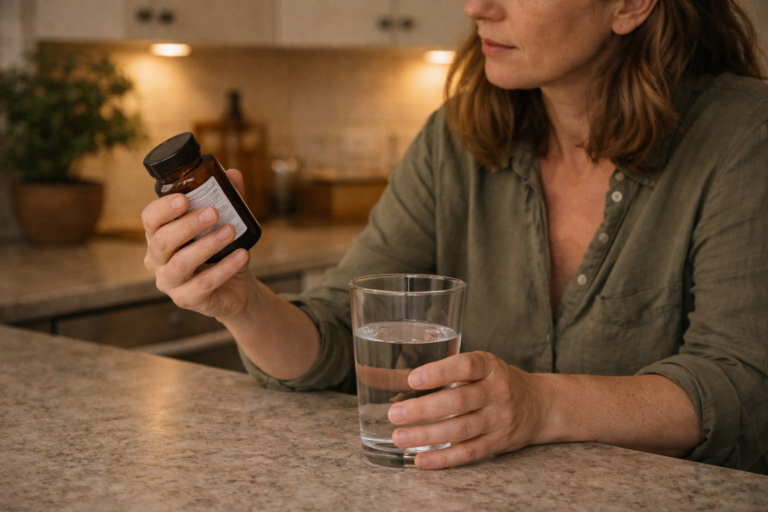
Biotin actually works, but only if you’re deficient. Most people in developed countries aren’t biotin-deficient unless you have something else going on (malabsorption, etc.). But it doesn’t hurt to take it, and if you’re on the lower end, it can support keratin production, which is the protein structure of your hair. Take 2.5 to 5 mg daily. You won’t see results overnight, but over months, finer hair will come in stronger. I use Biotin because the dose is solid and it’s not wrapped in marketing nonsense.
Collagen peptides might be your secret weapon. This one surprised me. Collagen is broken down into amino acids, particularly glycine and proline, which support hair follicle structure and longevity. Studies show that people taking collagen peptides report thicker hair, stronger nails, and better skin after 8-12 weeks. The mechanism makes sense: your hair is made of protein, and collagen provides some of the building blocks. I add collagen peptides to my coffee most mornings. Completely tasteless, doesn’t change the texture.
Consider a hair supplement designed for the perimenopause woman. Look for one that has a combination approach: biotin, DHT-blocking ingredients like saw palmetto or pumpkin seed oil, iron, and often adaptogens. Nutrafol is the one everyone talks about, but there are others. What you’re looking for is evidence-based dosing (not tiny amounts of seventeen ingredients), transparency about what’s in it, and third-party testing. You’re spending money to actually feel a difference, not to feel like you’re doing something.
Use a DHT-blocking shampoo. This is the topical layer of the strategy. A good DHT-blocking shampoo contains ingredients like saw palmetto, ketoconazole, or pumpkin seed oil. These don’t enter your bloodstream; they work topically on the scalp and follicle. Use it three to four times a week. It won’t cure anything, but combined with oral support, it helps signal your scalp to maintain thicker growth. Consistency matters here. One wash a week won’t do much. You have to actually use it.
Assess your stress and sleep. I know, I know. Easy to say when you’re waking up at 3 AM with a racing heart and then lying there catastrophizing about your hair. But cortisol is a real player. Chronic stress literally shortens the anagen phase. Better sleep, more movement, whatever reduces your personal stress (for me it’s morning coffee on the porch and telling my kids to leave me alone) actually helps your hair. It sounds fake but it’s not.
Give it time. Hair grows slowly. You don’t see results from oral supplements for three to four months. DHT-blocking shampoos take two to three months to show an effect. If you’re 14 days in and wondering why your hair hasn’t magically thickened, that’s not how biology works. Commit to four to six months of consistent supplementation and topical support.
The Part About Acceptance
Here’s the thing: some women’s hair thinning in perimenopause is genetic. Some of it is permanent (hair doesn’t just magically regrow when estrogen comes back; some follicles stay miniaturized). And some of it is just the body processing its midlife transition. Not every solution works for every person.
But most of it improves. When you stabilize your hormones (through HRT if you choose it, through cycle syncing and stress management if you don’t), your hair often comes back thicker. And in the meantime, taking your iron, your biotin, using a decent shampoo, and actually showing up for your follicles makes a measurable difference.
Your hair isn’t falling out because you’re broken. It’s falling out because you’re experiencing a massive hormonal shift that your body is responding to with perfect, predictable biology. The fact that it sucks doesn’t make it less scientific. And the fact that it’s scientific means it’s addressable.
Your shower drain will eventually get quieter again.