Collagen and Perimenopause: Why Your Skin, Joints, and Hair Are Changing (And What Actually Helps)
I knew about hot flashes. I’d heard about sleep. I had been mentally bracing for mood changes and brain fog since my late thirties.
What nobody told me was that my skin would start doing something weird around 42. It got thinner. Not dramatically, not overnight. But there was a quality to it that had changed — less resilient, somehow. A bruise took longer to fade. A small cut on my hand took ages to heal. The skin on my forearms started looking slightly… papery. The kind of skin I associated with patients in their seventies.
I mentioned it to a colleague and she looked at me the way nurses look at each other when we both know exactly what’s happening. “Collagen,” she said. “Estrogen runs the whole show.”
She wasn’t wrong.
What Estrogen Has to Do With Collagen
Collagen is the structural protein that holds basically everything together. Skin. Joints. Tendons. Ligaments. The walls of your blood vessels. Vaginal tissue. It’s the scaffolding your body runs on, and your body makes it constantly — or it did, anyway.
Here’s the thing about collagen production: estrogen is one of its primary regulators. Estrogen stimulates fibroblasts, which are the cells responsible for making collagen. High estrogen means active fibroblasts means robust collagen synthesis. It’s why skin in your twenties and thirties is plump and bouncy and heals quickly. You were swimming in estrogen, and your fibroblasts were working overtime.
In perimenopause, estrogen starts dropping. And collagen production drops with it. The research is pretty stark: women lose approximately 30% of their skin collagen in the first five years after menopause. Not over a lifetime. In five years. The rate of loss is fastest early on, then gradually slows — but the early years are dramatic.
This isn’t just a skin problem. Collagen is everywhere in your body. When production drops, you feel it in multiple places simultaneously.
What Collagen Loss Actually Feels Like
Your skin changes texture. This is usually the first thing women notice. Skin becomes thinner, drier, less elastic. Fine lines that weren’t there before appear. Skin that used to bounce back when you pinched it takes a beat longer to return. You might bruise more easily. Wounds heal more slowly. None of these are dramatic on their own but they accumulate into a noticeable shift.
Your joints start talking to you. Collagen is a major component of cartilage and connective tissue. When production drops, joints lose some of their cushioning and flexibility. Many women in perimenopause notice new joint stiffness — especially in the morning, especially in fingers, knees, and hips. This often gets dismissed as “just getting older” when it’s actually hormonal and, to some extent, addressable.
Your hair changes. Hair follicles sit in a collagen-rich matrix in the dermis. When that matrix starts thinning, hair can become finer, more brittle, slower growing. This overlaps with the DHT hair loss issue I’ve written about separately, but collagen loss is its own contributing factor — one that affects hair texture even when overall shedding isn’t dramatic.
Vaginal tissue thins. This one is uncomfortable to talk about but important to understand. Vaginal walls are partly collagen-based. Collagen loss contributes to vaginal atrophy — the thinning and drying of vaginal tissue that makes sex uncomfortable for many perimenopausal women. It’s not purely an estrogen story; it’s partly structural.
Where Collagen Peptides Come In
A few years ago I would have rolled my eyes at collagen supplements. It seemed like the kind of thing that sounded good in theory but probably just got digested into generic amino acids with no particular benefit. And honestly, that skepticism was partially warranted for a while.
The research has gotten better. Hydrolyzed collagen peptides — the form used in supplements — are broken down into smaller peptide fragments that your body absorbs efficiently and can actually use for collagen synthesis. Studies show measurable improvements in skin elasticity, skin hydration, and joint pain with consistent collagen peptide supplementation. The mechanism makes sense: you’re supplying the raw materials and the signaling peptides that stimulate your fibroblasts.
This does not mean collagen supplements overcome the hormonal deficit. They don’t replace estrogen. What they do is give your body the best possible substrate to work with given the circumstances. Think of it like this: if your collagen production is running at 70% of what it used to be, collagen peptides help make sure that 70% is as effective as possible.
What to look for:
Hydrolyzed collagen peptides — this is the form that’s actually absorbed. Not gelatin, not raw collagen. Hydrolyzed and broken down into peptides. The label should say “hydrolyzed collagen peptides” or “collagen peptide powder.”
Type I and Type III collagen — these are the types most relevant to skin, hair, and general connective tissue. Type II is specific to cartilage and joint health. Most supplements focus on Type I and III, which is fine for general perimenopause support.
Unflavored powder format — you can add it to anything. Coffee, smoothies, oatmeal. It dissolves completely and doesn’t change the taste. Flavored versions often have added sugar and tend to be overpriced.
Clean ingredient list — collagen powder, full stop. You don’t need a bunch of added vitamins and antioxidants mixed in; you can get those separately and at better doses.
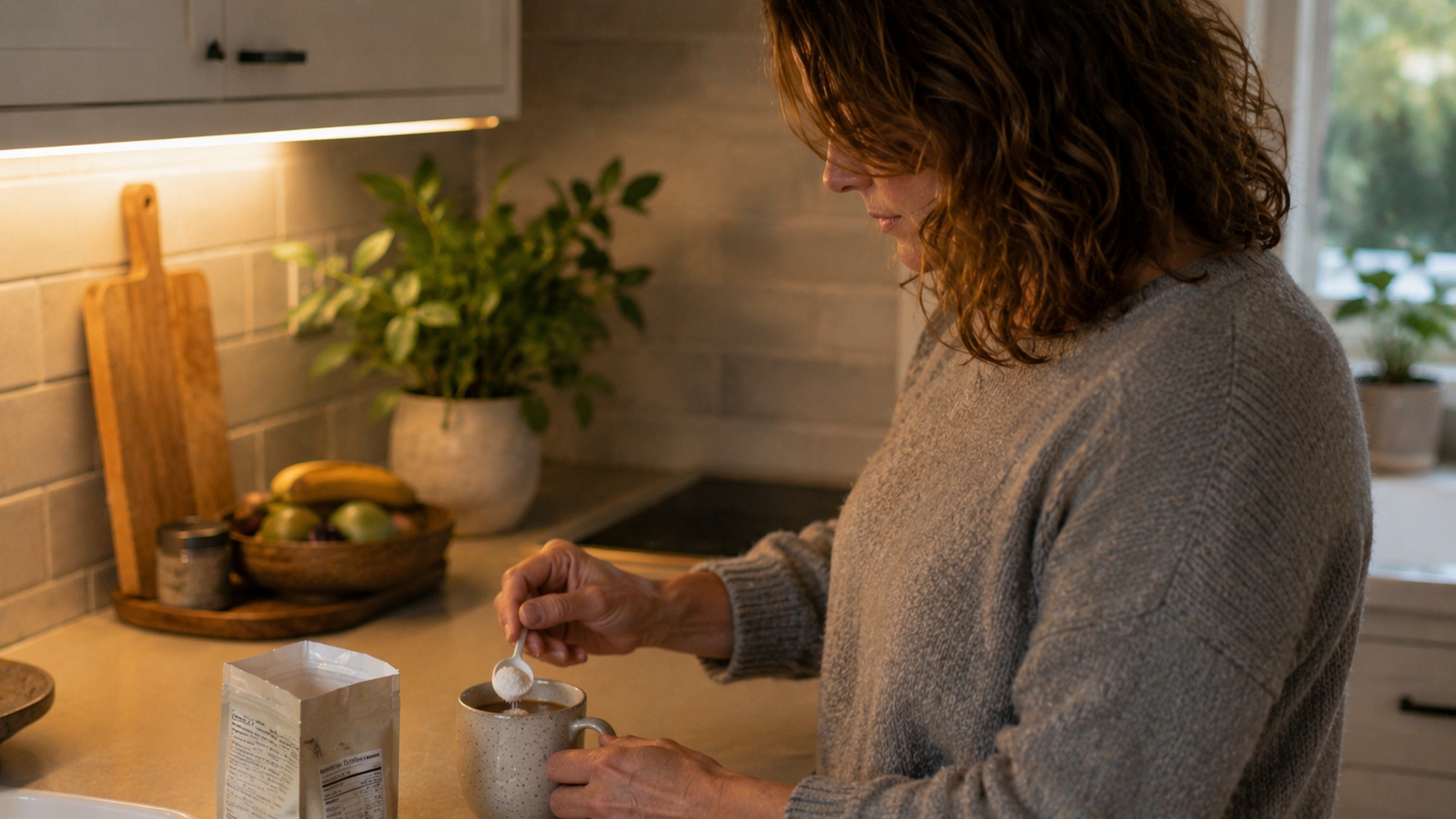
I’ve been adding collagen peptides to my morning coffee for about eight months. Completely tasteless, no texture change. I’m not going to tell you my skin looks 35 again because that would be a lie. But the papery quality I noticed has improved. My joint stiffness in the morning — which was getting noticeable — is genuinely better. Hair feels thicker in texture even if the volume hasn’t fully recovered.
That’s a reasonable outcome from a supplement that costs a couple dollars a day. Not a miracle. A real, modest, evidence-supported improvement.
The Vitamin C Problem
Here’s something that often gets skipped in the collagen conversation: collagen synthesis requires vitamin C. Not optional, not supplementary — actually required. Vitamin C is a cofactor for the enzymes that build collagen cross-links. Without adequate vitamin C, even good collagen peptide intake won’t translate fully into new collagen production.
Most people eating a reasonably varied diet have fine vitamin C levels. But if you’re eating the way many of us eat during perimenopause — stressed, rushed, not always prioritizing produce — it’s worth paying attention to. I aim for at least 200mg daily from food and supplement if I’m falling short. A simple vitamin C supplement is cheap and the upside is real.
The Bigger Picture
Collagen loss in perimenopause is real, it’s faster than most women expect, and it affects more than just wrinkles. The good news is that it’s one of the more addressable parts of the transition — not with creams (topical collagen doesn’t penetrate meaningfully) but with oral collagen peptides that actually reach your fibroblasts.
It won’t undo the hormonal shift. Nothing you take orally will fully compensate for what declining estrogen does to collagen production. But for women who aren’t on HRT, or who are on HRT and still noticing these changes, collagen peptides are one of the more evidence-backed things you can add to your routine.
Ten grams a day. In your coffee. You probably won’t notice anything for six to eight weeks, and then one day you’ll realize your skin feels a little different and your knees aren’t complaining on the stairs. Low drama, genuine effect.
Your scaffolding is worth maintaining.